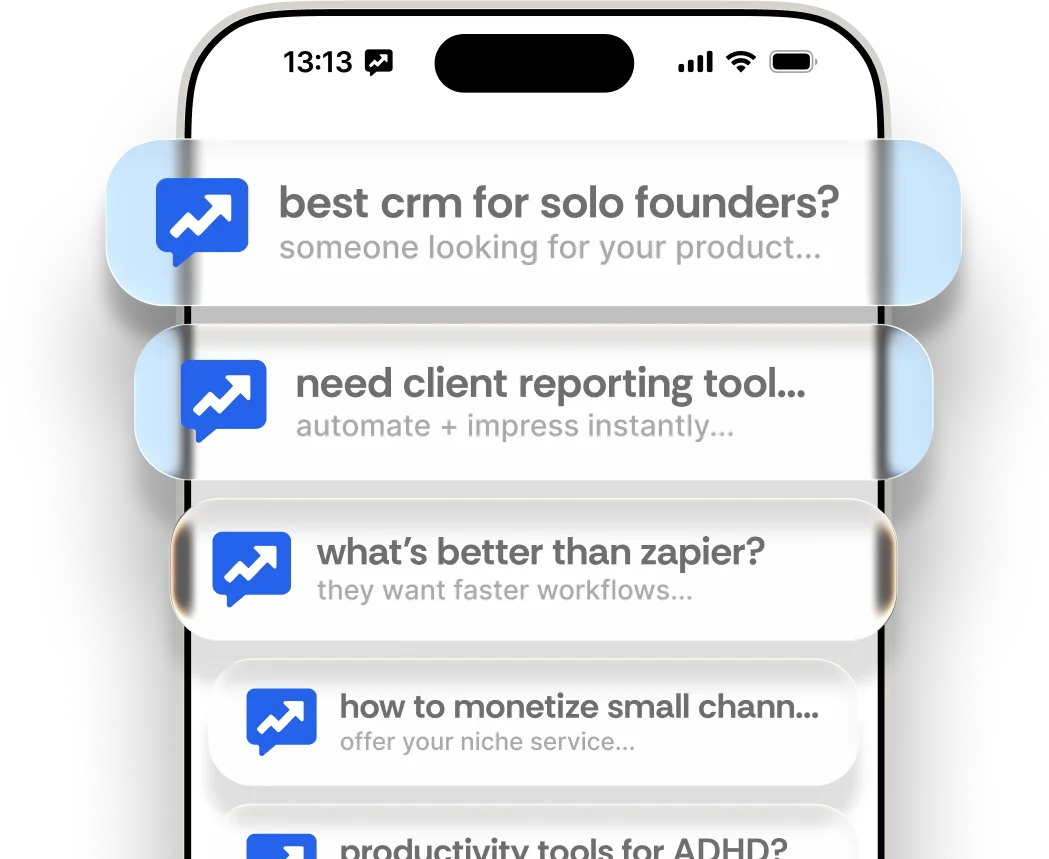
Most founders discover Reddit lead gen the same way: they’re browsing r/SaaS one afternoon, spot someone asking “what tool do you use for X?”, reply, and get a paying customer. Then they spend the next six weeks trying to recreate that moment manually - and fail.
Here’s the problem: the posts you need aren’t searchable on demand. Reddit’s search is terrible. Google’s Reddit indexing is inconsistent. The posts you want appear and age out in 2-3 hours. Manual searching doesn’t scale.
This is part of the How to Find Customers on Reddit in 2026 series.
What does “high intent” actually mean on Reddit?
Not every Reddit post is a lead. Most aren’t. High-intent posts have specific signals that distinguish active buyers from passive readers.
Direct signals (score: 70+)
- “Looking for a tool that does X” - explicit ask
- “Best [category] tool in 2026?” - recommendation request
- “Switching from [competitor], what do you recommend?” - competitor churn signal
- “Does anyone know a way to automate X?” - problem-seeking
Medium signals (score: 40–69)
- “Frustrated with [competitor], anyone else?” - pain point, no ask yet
- “What do you use for X?” without explicit purchase language
- “We’re evaluating [category] tools” - early-stage consideration
Low signal / noise (score: 0–39)
- “I love [competitor]” - not switching
- “Here’s how I built X myself” - DIY, not buying
- Category discussions without personal need
The key distinction: someone describing their problem (medium) vs someone actively seeking a solution (high). You want both, but high-intent converts in hours, not weeks.
What’s the manual approach that actually works?
If you’re starting out and want to validate the channel before investing in automation, you can cover 2–3 subreddits manually - but no more than that before it becomes a part-time job.
1. Monitor the right subreddits, not just your obvious ones
For most SaaS tools, the subreddit list is longer than you’d think:
- Your direct category (e.g.,
r/SaaS,r/startups) - Adjacent pain points (e.g., if you do lead gen:
r/sales,r/Entrepreneur,r/smallbusiness) - Competitor communities (watch for frustrated users)
- Job communities (
r/forhire,r/slavelabour) - often signal “I need a tool to do this”
2. Use Reddit’s search with the right syntax
Reddit’s search is weak, but these patterns help:
"looking for a tool" OR "what do you recommend" site:reddit.com/r/SaaS
"switching from" OR "alternative to" site:reddit.com/r/[yourcategory]
Run this in Google, not Reddit. Google indexes Reddit better than Reddit does.
3. Sort by “New”, not “Hot”
Hot posts are already getting replies - you’re late. Sort by “New” and check every 2-3 hours during business hours. High-intent posts get buried fast.
Where does manual searching break down?
Here’s what happens when you try to scale manual Reddit monitoring past 3–4 subreddits:
| Subreddits monitored | Time/day (manual) | Posts reviewed | Leads found |
|---|---|---|---|
| 3 | ~45 min | ~200 | 1-2 |
| 8 | ~2 hrs | ~600 | 3-6 |
| 20 | ~5 hrs | ~1,500 | 8-15 |
At 8 subreddits, you’re spending 2+ hours per day on Reddit monitoring alone. At 20, it’s a half-time job. And you still miss posts between check-ins.
The real problem: high-intent posts often appear at times you’re not watching, and they get answered within 1-2 hours. The founder who replies first gets the lead.
How do you automate Reddit monitoring properly?
There are two automation approaches, and they differ significantly in quality:
Approach A: Keyword alerts (free, noisy)
Tools like F5Bot send you an email every time your keyword appears. You set “project management” as a keyword, and you get 50 emails a day. Maybe 2 are actual leads.
Works fine for validating the channel. Unusable at scale because the noise ratio is ~95%.
Approach B: AI intent scoring (paid, signal-only)
The better approach uses a two-stage system:
| Stage | What it does | Cost |
|---|---|---|
| Stage 1: keyword match | Filter 100,000 posts/day down to ~500 that mentioned your keywords | Essentially free |
| Stage 2: AI intent score | Score only the 500 keyword matches - filter down to 15–30 real leads | ~$4/day vs $800/day for full corpus |
The critical efficiency trick: don’t run AI on everything. Running GPT-4o on 100,000 posts/day costs ~$800/day. Running it on only keyword-matched posts costs ~$4/day. Same result, 200× cheaper.
This is what ReplyGain does - keyword match first (free), AI score only the matches (cheap), surface only the leads (actionable).
What posts are you missing right now?
Here’s a sobering exercise. Pick any 3 relevant subreddits. Go to the “New” tab. Look at the last 72 hours. Count how many posts say something like:
- “Anyone recommend a good X tool?”
- “Frustrated with [competitor], looking for alternatives”
- “What do you use for Y?”
- “Is there an automated way to do Z?”
In a typical SaaS niche, there are 5-20 of these per week across a reasonable subreddit list. Every one of them is someone who either just paid someone else, or is still deciding.
If you’re only checking manually, you’re catching maybe 10% of them - the ones that happen to appear while you’re watching.
What’s the right reply structure when you find a lead?
Finding the post is step one. The reply is step two, and it’s where most founders fumble. The structure that converts without getting flagged: acknowledge the problem, give the useful answer, mention your product as context.
Don’t: Lead with your product. “Try ReplyGain!” as a first reply kills the thread and gets you flagged for spam.
Do: Answer the question first, mention your product second.
Good reply structure:
- Acknowledge the specific problem they mentioned
- Explain the general approach (not your product)
- Mention your product as one solution, with context on why it fits their situation
- End with a soft CTA (“happy to answer questions if useful”)
Example:
“For Reddit monitoring specifically, the key thing is getting past keyword noise - most tools alert on every mention, which creates a lot of signal-to-noise work. The ones I’ve seen work well use some form of intent filtering so you’re only reviewing posts where someone is actually looking for something.
We built ReplyGain for exactly this - it does two-stage filtering where AI only scores posts that already matched your keywords, so you get maybe 5-10 leads/day vs 200 alerts. Happy to answer questions if that’s the direction you’re looking.”
That structure works because it leads with value, establishes credibility, and makes the product mention feel earned.
If you want to skip the manual part entirely and start with automated monitoring, ReplyGain scans Reddit, Hacker News, Bluesky, and X 24/7 and surfaces only the posts worth replying to.
Setup takes under 5 minutes. Paste your URL and it suggests keywords and subreddits automatically.