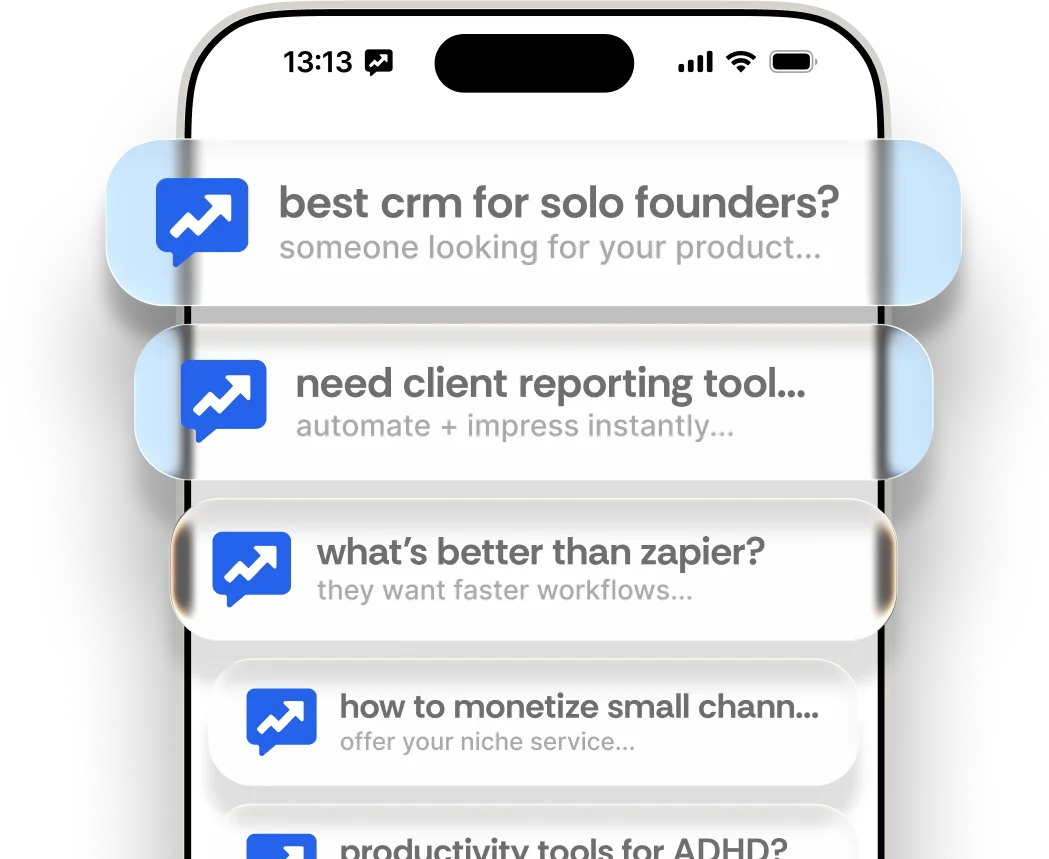
Paid ads at $0–5k MRR are almost always a money pit. The CAC is too high, the feedback loop is too slow, and you haven’t validated your message yet. The founders who hit 100 customers fastest use channels where they can have real conversations with people who already have the problem.
Here’s what actually works.
This is part of the How to Find Customers on Reddit in 2026 series.
Which channels produce the first 100 customers fastest?
The fastest-growing early-stage products share one trait: they found buyers who were already looking, rather than interrupting people who weren’t. Reddit, Hacker News, and warm communities outperform cold channels at this stage.
| Channel | Time to first lead | Conversion rate | Cost | Scales past 100? |
|---|---|---|---|---|
| Reddit intent replies | Hours | 8–15% | $0–29/mo | Yes, with tooling |
| Hacker News (Ask HN) | Hours | 10–20% | $0 | Limited volume |
| Community Slack/Discord | 1–3 days | 5–12% | $0 | Limited volume |
| Cold email (generic) | Days | 0.5–2% | Low | Yes |
| Cold email (context-first) | Days | 3–8% | Low | Yes |
| Content/SEO | Months | Variable | $0–300/mo | Yes |
| Paid ads | Immediate | 1–3% | High | Yes |
| Product Hunt launch | 1 day | Spike only | $0 | No |
The intent-first principle
The difference between a warm lead and a cold lead isn’t just conversion rate - it’s the entire sales dynamic. When someone publicly posts “looking for an alternative to [X], any recommendations?” they have:
- An active problem (not hypothetical)
- Budget allocated (they’re already paying for the current tool)
- A decision timeline (they’re evaluating now)
- Social proof signal (their post suggests others have the same problem)
This is fundamentally different from a cold email where you guessed someone might have this problem.
The first 100 customers who come from warm intent channels often become your best early advocates. They found you because they needed you - not because you interrupted them.
Step 1: Reddit and Hacker News (days 1–30)
Set up monitoring for your product category across the right subreddits and HN. Reply to every relevant post within the first hour if possible.
What to monitor:
- Your product category keywords (“tool for X”, “alternative to Y”)
- Pain language (“manually doing X every day”, “I hate that Z takes so long”)
- Competitor mentions (“[Competitor] is too expensive”, “switching from [tool]”)
Time investment: 20–30 min/day for manual triage, or 10–15 min/day with an intent scoring tool.
What good looks like: 3–5 high-quality replies per week on the right threads, 1–2 trial signups per week from those replies.
See best subreddits for SaaS customers for the full community list.
Step 2: Context-first cold email (days 15–45)
Cold email only works when you have context on why you’re emailing. “I found your post on Reddit asking about X” converts 3–5× better than a generic cold email.
The formula:
- Find their post or comment on Reddit/HN/Twitter
- Note the specific problem they described
- Email: “I saw your post about [specific problem] - we built [product] because of the exact same frustration. Would a 15-min call be useful?”
This works because:
- You’re not guessing they have the problem - you know
- The reference makes you memorable and credible
- The conversation starts from their problem, not your pitch
Volume: 10–20 personalized emails/week. Low volume, high quality. Not 200 generic emails.
Step 3: Build in public (ongoing)
Sharing your journey publicly - revenue numbers, product decisions, hard lessons - builds an audience that becomes customers. This is a slow channel but compounds over time.
Founders who built in public and hit early traction share one pattern: they documented failures as openly as wins. The communities that respond most to this are Hacker News (Show HN), X/Twitter (#buildinpublic), and Indie Hackers.
What to share:
- Month 1–3: What you’re building and why, what’s not working
- Month 3–6: Real numbers, what changed, what you learned
- Ongoing: Weekly or biweekly updates
Timeline: Expect 3–6 months before this channel drives meaningful signups.
Step 4: Direct community participation (ongoing)
Every niche has Slack groups, Discord servers, or Facebook communities where your buyers hang out. Being genuinely helpful in these spaces for 4–8 weeks before you ever mention your product builds trust that paid ads can’t buy.
Find communities by:
- Searching “[your category] community” or “[your category] Slack”
- Checking the sidebar of relevant subreddits (many link to their Discord)
- Asking your first customers where they spend time online
The key rule: answer 10 questions before you mention your product once. This isn’t a ratio to game - it’s the point where you’ve actually built enough context to mention your product without it feeling like an ambush.
What doesn’t work for the first 100
| Channel | Why it fails early |
|---|---|
| Google/Facebook ads | CAC too high before you’ve optimized the funnel |
| SEO content | Takes 4–12 months to rank |
| Influencer partnerships | Low intent, hard to track, expensive |
| Product Hunt launch | One-day spike, not sustainable |
| Generic cold email blasts | Response rate too low to be worth the time |
| AppSumo / LTD deals | Attracts deal-hunters, not your ICP |
These channels work eventually - but they’re late-stage optimization. For the first 100 customers, warm intent channels and direct conversation win every time.
Automating the Reddit/HN monitoring at scale
Once Reddit leads start converting, set up proper monitoring so you’re not missing opportunities. ReplyGain monitors Reddit, HN, X, and Bluesky simultaneously, scores posts by purchase intent, and queues the high-intent ones for your review.
The goal is to turn a 2-hour daily manual task into a 10-minute review session.